
Marketing Agency vs Marketing Strategy Consultant in Brisbane: Which Is Right for Your Business?
Choosing between a marketing agency and a marketing strategy consultant in Brisbane is a decision that shapes how your business grows, how your budget performs, and how clearly your team understands the direction ahead. Most businesses default to agencies because the model is familiar. But familiar is not always the right fit, especially when what you actually need is strategic clarity rather than another bundle of deliverables.
This post cuts through the noise. Whether you have already worked with an agency and felt something was missing, or you are evaluating your options for the first time with serious intent, what follows is a practical, honest comparison of both models. You will learn what a marketing strategy consultant actually does, how different engagement models work, why strategy-first thinking can be valuable for growth-focused businesses, and how AI integration is changing what good strategic support looks like right now.
By the end, you will have a clear framework for making the right call, and a sharper understanding of what to look for when evaluating a marketing strategy consultant in Brisbane.
You've Tried the Agency. You've Done the Course. Here's What's Actually Missing.
If you are a founder or in-house marketer reading this, there is a reasonable chance you have already spent serious money on marketing. An agency retainer, maybe two. A course that promised a framework. A suite of tools that each solved one problem without connecting to anything else.
The results were probably inconsistent, and the reasons were hard to pin down.
Here is what can happen when marketing activities are executed in isolation: the SEO work does not inform the email strategy. The paid ads run independently of the content. Nobody is responsible for the architecture underneath, because nobody was hired to build one. What you have is a marketing checklist, not a marketing system.
The distinction matters for growth-stage businesses. A checklist tells you what to do. A system determines why, in what order, toward what outcome, and how each piece reinforces the others. Without that connective layer, more activity can simply produce more noise.
This is not necessarily a beginner's problem. The frustration described above can belong to people who understand marketing and have already invested in it. The gap may not be knowledge or budget. It may be strategy architecture.
The rest of this article is a framework for evaluating whether a marketing strategy consultant is the next right move, or whether a different model still makes more sense for where you are now.
What a Marketing Strategy Consultant Actually Does (Versus What Agencies Sell)
So what does a strategy consultant actually deliver, if not ads, content, or a social media calendar?
The core deliverable is strategic direction: a clear logic for which channels to use, in what order, for what purpose, and measured against which outcomes. That framework can provide the connective layer between individual marketing activities. Not necessarily more activity, but a system that makes activity coherent.
This can be structurally different from a traditional agency engagement. Agencies can provide specialist teams and ongoing execution across channels, while consultants may focus more heavily on diagnosis, prioritisation, strategy and advice. The distinction is not absolute — some agencies provide substantial strategic work, and some consultants also provide hands-on support. Current Brisbane agency listings, for example, show agencies offering combinations of digital strategy, marketing strategy, SEO, paid media, social media and content services. Clutch's Brisbane digital marketing agency listings provide a useful snapshot of how these services are packaged in the market.
A good strategy consultant starts somewhere many businesses need before commissioning more activity: diagnosis. That means auditing what you are already running, identifying where the system breaks down, and building a prioritised roadmap before recommending new spend. The output is clarity on what to do, in what order, with what you already have.
The key question is therefore not simply "agency or consultant?" It is "what problem am I actually paying someone to solve?"
Agency vs. Marketing Strategy Consultant: A Practical Comparison
That distinction in service model translates directly into a practical decision. Here is how the two options can compare across five dimensions that matter to growth-stage businesses.
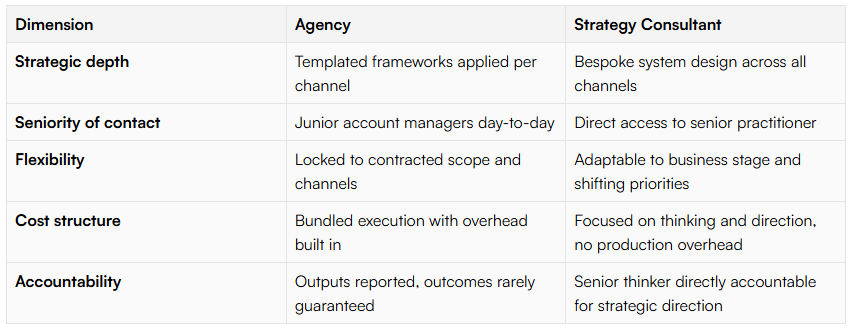
The agency model has genuine strengths: production capacity, specialised execution teams, and the ability to run multiple channels simultaneously. If you already know what needs to be done but do not have the people or capacity to do it, an agency can be the right choice.
The consultant model is different. Senior strategic thinking is the core deliverable, rather than a preamble to a large execution team. Depending on the consultant, implementation may remain with your internal team or other delivery specialists.
The practical implication is simple: if strategic direction is the constraint, rather than execution capacity, the consultant model may be the better fit. Before you decide, confirm which constraint is actually limiting you.
If you have neither strategy nor execution in place, a hybrid model combining consultant-led strategy with separately engaged delivery resources is also worth considering.
Retainer, Standalone Block, or 1:1 Session: Which Engagement Model Fits Your Stage?
Once you've confirmed a consultant is the right fit, the next decision is structure: how much ongoing access do you actually need, and what are you trying to solve?
Retainer
Embedded retainer support suits businesses that want ongoing strategic direction, accountability and momentum rather than a one-off plan. Vanessa Peel's Marketing Consultancy Retainer currently includes a 90-minute strategy session each week, documented strategies and plans, custom templates, research, competitor analysis and audience insights. It has a three-month minimum and is positioned as strategic support rather than a done-for-you marketing service.
Consulting Block
A standalone consulting block is project-based and time-bound. If you're entering a new market, repositioning your brand, or building a channel strategy from scratch, this model can provide a defined piece of strategic work with a clear endpoint.
Vanessa's Marketing Consulting Blocks are scoped to the business and billed by the hour. The service includes preparation, meetings, research and a written summary and action plan, without an ongoing retainer commitment.
You're not buying ongoing access; you're buying focused strategic direction around a defined problem.
1:1 Strategy Session
A focused 1:1 strategy session is the lowest-commitment starting point. It suits founders or marketers with a specific decision or challenge they want to pressure-test before committing to a larger engagement.
Vanessa's 1:1 Marketing Session is a one-off 90-minute Zoom session built around the client's specific agenda. It includes personalised advice, a prioritised action plan and a recording, with the stated focus on strategic advice rather than execution.
The important distinction is that these are three different levels of support, not three versions of the same service.
Why Strategy-First Consulting Can Be Valuable for Growth Businesses
The engagement model you choose matters, but it only delivers value when there is genuine strategy beneath it. When tactics run without a connected strategy, it can become difficult to understand how individual activities contribute to the broader business objective.
Your paid media data can inform decisions about messaging and conversion. Your SEO research can influence content priorities. Your customer and audience insights can shape email and lead-generation activity. The value of strategy is in making those connections deliberate rather than accidental.
It is also worth challenging the idea that agencies and consultants have fundamentally opposing incentives. An agency can provide excellent strategic thinking, while a consultant can provide poor advice. The provider's business model is only one part of the decision.
A more useful question is whether the engagement gives you the level of strategic input you need, alongside the execution capability required to act on it.
Current Brisbane industry listings demonstrate that strategy and execution frequently overlap: agencies may offer digital strategy, marketing strategy, SEO, paid media, content and social services within the same engagement.
So the case for strategy-first consulting is not that agencies are inherently inferior. It is that some businesses have an execution problem, while others have a decision-making and prioritisation problem. Those require different solutions.
AI-Integrated Marketing Strategy: What It Means and Why It Matters Now
Most of the AI conversation in marketing is noise. The meaningful distinction is not simply whether you use AI, but how: as a content production shortcut, or as a tool that can improve how your marketing operation works.
AI is increasingly being used across marketing for activities including content creation, personalisation, automation, data analysis and targeting. The American Marketing Association's reporting on the CMO Survey highlights the growing use of AI across areas including content creation, personalisation, automation and data analysis.
AI can also support more sophisticated personalisation. McKinsey's research on personalised marketing describes how AI, analytics and customer data can be used to scale more personalised customer experiences.
For a small or growing business, however, that does not necessarily mean you need predictive models or a complicated AI stack.
The more immediate opportunity may be simpler: using AI to support research, content development, reporting, workflow automation, customer segmentation, personalisation and decision-making.
This is why AI capability works best inside a strategy-first model rather than alongside it. The tools matter, but the strategic questions come first: What are you trying to achieve? Which customers matter most? Which channels deserve attention? What should be automated, and what still requires human judgement?
AI can increase the leverage of a well-designed marketing system. It cannot compensate for a poorly designed one.
Senior-Level Thinking Without the Agency Price Tag: About Vanessa Peel
Vanessa Peel is a Brisbane-based digital marketing consultant with 15+ years of experience. Her current service positioning covers areas including marketing strategy and planning, SEO, content strategy, email marketing, lead generation, AI tools and marketing workflows, brand positioning, conversion optimisation, analytics and team capability.
The consultancy is built around helping founders, operators and small businesses create marketing systems they can actually implement, rather than simply adding more tactics. Vanessa's site describes the approach as bringing strategy, systems and processes that businesses can implement themselves.
The engagement model is structured around direct strategic support rather than a large agency team. The current retainer, for example, provides a weekly 90-minute strategy session alongside research, documentation, strategies, templates and planning between sessions.
That makes the model particularly relevant to businesses that already have some marketing activity underway but need greater clarity about what to prioritise, how the pieces should connect, and what to do next.
How to Evaluate a Marketing Strategy Consultant Before You Commit
Knowing what to look for makes the difference between a productive engagement and another expensive disappointment. Use these five questions as your evaluation filter.
Does the consultant diagnose before they prescribe? A credible engagement should begin with your specific business context. If the first conversation sounds like a pre-built package being described rather than questions being asked, that tells you something about the methodology on offer.
Who will you actually work with? Ask directly. In larger agency models, the person who pitches the work may not be the person delivering it. In a boutique consulting model, clarify exactly who will be responsible for the strategic work and how much direct access you receive.
Can they connect the channels, not just cite them? Ask for their view on how SEO, email, paid media and content should interact in your particular business. You are looking for someone who can explain the reasoning behind the recommendations, not simply list channels.
What is the output, and can your team action it? Strategy that requires resources you do not have is not useful strategy. Clarify the deliverable format and test it against your current capacity before committing.
Can they speak to AI integration? AI is now being used across multiple marketing functions, so a modern marketing consultant should at least be able to explain where AI could realistically improve your workflows, research, content, analysis or customer experience.
Making the Right Call for Your Business
Once you've worked through the evaluation criteria, the decision usually becomes clearer.
If you've invested in agencies, tools, or channel specialists and still lack coherent direction, the missing piece may be strategy rather than more execution. Adding another tactic to a system that isn't connected will not necessarily fix the underlying problem.
If, on the other hand, you know exactly what needs to be done but lack the people, skills or production capacity to do it, an agency may be the more appropriate choice.
And if you have some internal capability but need senior direction, independent challenge or help prioritising where to spend your limited resources, a consultant may fill the gap.
There is no universally superior model. The right choice is the one that matches the problem you actually have.
Conclusion
The right marketing partner is not the one with the biggest team or the longest service list. It is the one whose model is built around the problem your business actually needs to solve.
If you need a team to execute a clearly defined strategy, an agency may be the right fit.
If you need someone to diagnose the problem, challenge your assumptions, connect the moving parts and give you a clear direction, a marketing strategy consultant may be the better choice.
And if you are not sure which level of support you need, starting with a focused conversation can be a sensible first step.
The goal is not to buy more marketing.
It is to make the marketing you are already doing work harder, with greater clarity and purpose.
FAQs
What's the core difference between an agency and a consultant?
Agencies typically focus on execution and production capacity. Consultants focus on strategic direction and diagnosis first.
Which is cheaper, an agency or a consultant?
Neither is inherently cheaper, you're paying for different things: a delivery team versus senior strategic time.
How do I know if I need strategy or execution?
If you already know exactly what needs doing but lack the people to do it, that's an execution gap. If your activities feel disconnected, that's a strategy gap.
Can a consultant also help with execution?
Some do. Clarify this upfront, since the models can overlap more than the labels suggest.
What should I ask before hiring either one?
Whether they diagnose before they prescribe, and whether they can explain how your channels should connect, not just list them.
Is a retainer or a one-off session better for me?
A one-off session suits a specific decision. A retainer suits ongoing strategic support and accountability.
Do I need AI expertise from whoever I hire?
Increasingly yes. A modern marketing consultant should be able to explain where AI realistically improves your workflows.
What if I've already tried an agency and it didn't work?
That often points to a missing strategic layer rather than poor execution. Worth diagnosing before adding more activity.
How much does a Brisbane marketing strategy consultant typically cost?
It varies by engagement model, day-rate retainers, hourly blocks, and one-off sessions all price differently based on scope.
What's the biggest red flag when evaluating a consultant?
If the first conversation sounds like a pre-built package being pitched, rather than questions being asked about your specific business.